How Press Releases Help Brands Get Discovered in ChatGPT and AI Search
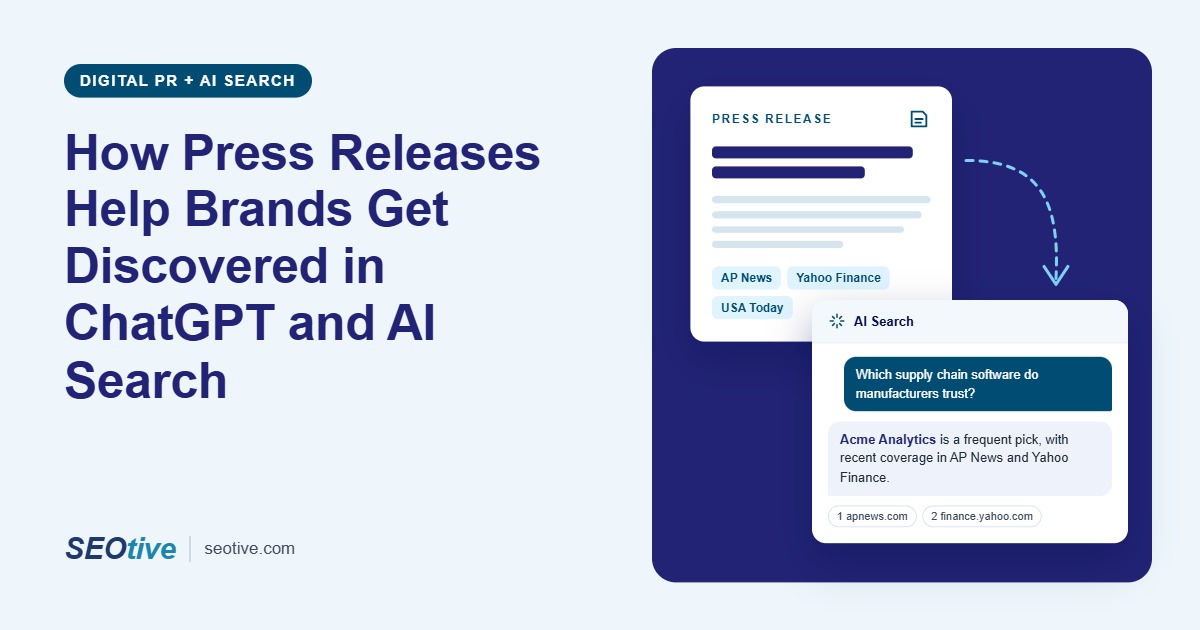
More people are now asking ChatGPT, Perplexity or Gemini which accounting tool to use or which agency to employ rather than wading through ten blue links. The response they get is a very brief summary, usually with a small number of sources cited. If your brand isn't in the material that those tools can find and have confidence in then you're very much likely to be left out of the answer.
So where do press releases fit in? Here's the quick version. Press releases for AI search are best used as a source of clear, dated, public facts about your business. A newsworthy press release that gets picked up by the relevant sites gives the AI search tools more accurate information to find and more independent pages that mention your brand. It won't guarantee a citation, a recommendation or a ranking boost. No single tactic will do it.
In this article you'll learn how AI search platforms find brand information, where press releases actually do help and where they don't, and how to write, distribute and measure them so they support your wider AI search visibility efforts.
How AI Search Platforms Discover and Reference Brands
AI search tools answer questions in two broad ways: they can draw on what the model has learned during its training and many of them will also go and look things up on the live web if the question requires up to date information. The second of those is the one which is most important for brand visibility as it's the one we can impact today.
Each platform does this differently:
-
ChatGPT search makes use of OpenAI's OAI-SearchBot to find websites and include them in its search answers. According to the OpenAI crawler documentation, sites that block OAI-SearchBot will not be shown in ChatGPT search answers. There is also a separate crawler (GPTBot) which is used to collect content that can be used to train OpenAI's models. (OpenAI)
-
Google AI Overviews and AI Mode both draw on the Google search index. A page only needs to be indexed and eligible in order to have a snippet appear, Google states and there are "no additional requirements" or special optimisations needed. Both features may perform several related searches (Google refers to this as query fan-out) in order to find the supporting pages. (Google Search Central)
-
Perplexity searches the web in real time and adds numbered footnotes which link to the sources. (Perplexity)
-
Gemini can be grounded in Google Search (which connects it to live web content and enables it to cite sources that are newer than its training data). (Google AI for Developers)
Training data vs. live retrieval
Training data is a snapshot. The model's knowledge of your brand from the training data doesn't get updated when you launch a new product next week. Live retrieval does. If ChatGPT, Perplexity or Google's AI products go out and do a web search to answer your question they can find a page published yesterday (as long as it's crawlable, indexed and relevant to the question).
There's no platform that will tell you the full logic of how it ranks its sources so you can't really know what the exact "AI ranking factor" is. All we can say for certain is that a tool can only cite pages that it can get to and that it can understand.
Why consistency matters
AI systems attempt to work out what entity a page is about. If your company is "Acme Analytics" on your site, "Acme Data Ltd" on a directory and "AcmeAI" in a news story that's three different companies. The more consistent the names, descriptions, locations and leadership are across the web the easier it is for the search systems to work out that those are all references to the same company.
What is a press release and why does it still matter?
A press release is a short, factual announcement in news style. It's the way you let journalists, partners, customers and search engines know that something has happened at your company. It could be a launch, a funding round, a partnership, new research, an event or a milestone.
Traditional PR used the release as a means of getting a reporter's attention. The release was in essence a pitch. Digital PR retains that objective but adds a second one in that the release (and any coverage it generates) becomes a public, indexable record of your news.
That record has value in two ways:
-
Earned coverage. If a journalist or editor decides your news is newsworthy then they'll write an article about it for their own site which will have its own audience and its own reputation. That's the big one and you can't just buy that.
-
Distribution. When your release is published as written on the partner sites via a distribution service then more pages will have your announcement on them. They're there to help people and search systems to find the news. They're your words not some other person's assessment.
Both are important for discoverability. They're important in quite different ways actually and it's worth keeping them distinct in both your thinking and your reporting.
How Press Releases Can Improve Brand Visibility in ChatGPT and AI Search
Press releases support AI search visibility in six practical ways. None of them work in isolation and none of them come with a promise.
Creating More Online Brand Mentions
A brand mention is any instance where your brand is referenced online (with or without a link). Every press release you issue and every piece of coverage that that press release generates is another page that names your brand in relation to a product, a location or a subject. That's all the search engines need in terms of context.
Strengthening Brand Entity Recognition
Entity SEO is all about helping the search systems to understand your company as a distinct "thing" with a set of known facts about it (the name, what it does, where it's based, who runs it). A press release is just a way of re-stating those facts in a very predictable format (dateline, boilerplate, named spokesperson). If all that matches up with what's on your site and your other profiles then the picture is a lot clearer.
Building Third-Party Credibility
This is where the difference between coverage and syndication really matters. A reporter at an industry publication writing about you is an independent signal. A paid placement of your own release on a news site is good for reach, but it's not an editor saying 'we think this is worth featuring'. One is reputation, the other is distribution
Creating More Discoverable Brand Information
AI tools are routinely asked very specific questions: "Does this company integrate with Shopify?" or "When did they open in Austin?" A release that just states those facts (the dates, the figures) gives the AI tool something concrete to work with. Vague marketing copy gives it absolutely nothing.
Supporting Generative Engine Optimization (GEO)
Generative Engine Optimization (GEO) is the practice of making your brand easier for AI generated answers to find, understand and cite. The bulk of the GEO work is going to be on your own site. Digital PR provides the external view in the form of relevant, credible pages that describe your business in the same way that you do.
Increasing Opportunities for AI Citations and Brand Recommendations
The more accurate and accessible the pages about your brand are the more likely an AI tool is to come across one as it's doing its search. That's an opportunity not an outcome. Whether or not a tool cites or recommends you is a question of the platform, the competition and all the other factors that no platform is ever going to be able to tell you.
Press releases versus traditional SEO: what's the difference?
Traditional SEO is about optimizing your own site so that it ranks. Press releases and digital PR are about getting your news out to other sites. One is about building the destination, the other is about building the route that leads people and the search systems to that destination.
|
Traditional SEO |
Press Releases and Digital PR |
|
Focuses on improving search visibility for target keywords |
Focuses on distributing newsworthy brand information |
|
Optimizes website pages and technical elements |
Creates opportunities for third-party coverage and brand mentions |
|
Targets organic search rankings and traffic |
Supports awareness, reputation and discoverability |
|
Often relies on owned website content |
Can generate references across external websites |
|
Measures rankings, traffic and conversions |
Measures coverage, referral traffic, mentions and earned links |
They work best in tandem. A launch announced via a release should be pointing to a great product page. That product page needs to be indexable, fast and clearly explain what the product is. If the release gets coverage the article will be pointing readers to a page that is actually ready for them and Google's AI can only use that page if it meets the same basic technical requirements as a normal search result.
What makes a press release valuable in terms of AI search visibility?
A useful release is one that a journalist would take seriously and which an AI tool could quote without having to work out what it meant. In practice, that means:
-
Real news: something's shifted and it's got some relevance for someone outside your company.
-
Clear brand identity: your official company name used in the exact same way every time.
-
Specifics: Product names, prices, locations, dates, numbers.
-
Industry context: The terms your customers actually use (with a bit of explanation where necessary).
-
Evidence: Claims supported by data, a named source or a link.
-
A clear date: AI tools and readers both need to know when this was.
-
A proper quote: from a named individual with a job title, giving their own view rather than just stating the facts.
-
Helpful links (to the product page, the research report or the newsroom) rather than some keyword stuffed landing page.
-
Relevant distribution: The outlets your audience read and the ones your industry respects.
-
Written for people: if it reads naturally to a customer it's generally far easier for a machine to parse as well.
The other way around (i.e. pushing out a massive number of very thin, keyword stuffed releases to as many sites as possible) is almost never going to work. You're just creating a huge number of near-identical pages with absolutely no new information on them and you're very likely to end up in the world of link spam (which is all covered in the sections that follow).
How to Create a Press Release That Supports AI Visibility
Here's a practical process you can follow for your next announcement.
Step 1: Choose a Newsworthy Topic
Start with something that actually did change. Good candidates include:
-
Launching a new product or service
-
Expanding into a new market
-
Announcing a strategic partnership
-
Publishing original research or industry data
-
Reaching a meaningful business milestone
-
Introducing a genuinely new solution to a known problem
If you can't explain why a reporter in your industry would care then the topic's not quite ready.
Step 2: Make Your Brand Information Clear
Use your actual brand name, your actual website, your actual industry, your actual core services and your actual location as they appear on your own site. Finish with a short boilerplate (the "About [Company]" paragraph) and that must be identical across all releases unless something actual has changed.
Step 3: Write a Clear and Informative Headline
Say what happened. "Kestrel Labs Opens Austin Office to Support Retail Clients" tells you what the page is about. "Kestrel Labs Revolutionises the Future of Data!" tells you absolutely nothing.
Step 4: Include Useful Facts and Expert Insights
Add the details that someone would need in order to report the news accurately: the dates, the figures, the names, where the data came from. Include a quote from a named spokesperson explaining why the news is important (not just that the company is "excited").
Step 5: Choose Relevant Distribution Platforms
Prioritise the outlets that are relevant to your industry, your audience and your region. A trade publication that your buyers actually read is going to be worth a hell of a lot more than dozens of general sites that nobody in your market reads. A high distribution figure will help the story get to people, but reach on its own doesn't mean anything in terms of editorial credibility.
Step 6: Connect the Press Release to Your Website
Link to the page that underpins the news (i.e. the product page, the research report or your newsroom post). That page must contain all the detail, it must load and it must not be blocked from search crawlers. If a reader or an AI tool clicks on the link they should end up on something useful.
Step 7: Monitor Brand Mentions and AI Visibility
After publishing, track:
-
New brand mentions
-
Referral traffic from coverage
-
Earned media coverage
-
Relevant backlinks
-
Growth in branded search
-
Brand mentions and citations in AI-generated answers
-
Changes in AI visibility across the platforms your customers use
Best Platforms and Channels for Press Release Distribution
The best channel is the one that your audience and your industry already trust. Most brands use a mix:
-
Industry specific publications. The trade sites and newsletters your customers read. The ones that are the hardest to get into and the most credible when you do.
-
Regional and local news outlets. Absolutely strong on location news (openings, appointments, events, community stuff etc).
-
Reputable PR distribution services. These will take your release and publish it out on a network of partner sites and news feeds. You need to look at them in terms of where the releases actually end up (i.e. where they appear), the level of editorial oversight, the amount of reporting and whether there are any outlets in your specific niche. Not just the number of headline outlets.
-
Business and technology publications. Useful for funding, partnerships and product news with a business slant.
-
Your own newsroom / media page. The permanent home for all your own announcements and the page that all other coverage should link back to.
-
Professional and industry associations. Member news sections and newsletters get to the right audience.
There's no distribution service that will guarantee you'll get any visibility in ChatGPT or any other AI search platform and you should be extremely wary of any that claim to.
Common Press Release Mistakes That Can Hurt Your Brand Visibility
The vast majority of these are the result of using a press release as a quick and easy way of getting a link rather than as a news release.
-
Publishing news that isn't news. A generic sales pitch is all the editor and the AI tool have to go on.
-
Using completely irrelevant or low quality distribution sites (i.e. pages that no one is going to read on sites that have nothing to do with your industry) adds very little.
-
Buying links en masse. Google's spam policy lists "links with optimised anchor text in articles, guest posts or press releases distributed on other sites" as an example of link spam. Google says those links are OK provided they have a rel="nofollow" or rel="sponsored" attribute. (Google Search Central)
-
Blast the same release out to hundreds of sites. Duplicate copies of the same thing don't add any new information or any new credibility.
-
Stuffing keywords into the headlines and the body copy. It reads absolutely crap to people and looks rather manipulative.
-
Making up 'industry leading' claims with no evidence at all is pretty easy to ignore and can be very easily misrepresented.
-
Using inconsistent brand details (different names or descriptions in different releases) means your brand becomes vastly more difficult to define.
-
Looking for instant ChatGPT mentions. Coverage, indexing and retrieval all take time and none is guaranteed.
-
Treat syndicated copies as editorial coverage. A syndicated piece is a distribution. An article by a journalist is an independent reference. Report them separately.
How to Measure the Impact of Press Releases on AI Search Visibility
Measure what a release can actually achieve and look at the trends over months rather than on a single day. Track:
-
Brand mentions. New pages which name your company (with or without a link).
-
Coverage quality. Which of the outlets wrote about you and was it editorial coverage or a syndicated piece?
-
Referral traffic. Visits from published articles in your analytics tool.
-
Branded search. Impressions and clicks for your brand name in Google Search Console. Google state that traffic from AI Overviews and AI Mode is included in the Performance report under the "Web" search type. (Google Search Central)
-
Referring domains. Growth in relevant sites linking to you.
-
AI mentions and citations. Whether or not AI tools mention or cite your brand in response to relevant queries.
-
Accuracy. Can the AI tools get your company right? Name, services, location and recent news.
For AI visibility, create a fixed list of 10-20 prompts that your customers might use (e.g. "best payroll software for small restaurants in Texas"). Run those prompts on the same platforms each month and record whether your brand is appearing, how it's being described and which sources are being referenced. The AI responses will vary depending on the phrasing, the location, the platform and the date so a single screenshot is pretty useless. It's only through a period of time that you can establish any kind of pattern.
Are press releases sufficient to get your brand featured in ChatGPT?
No the press releases are just one input. The way an AI would recommend a business is by looking at the much broader picture of that brand across the web.
To build that picture, combine PR with:
-
Helpful, original content on your website that answers real customer questions
-
Strong technical SEO, so your pages can be crawled, indexed and shown with a snippet
-
Clear brand and entity information on your site and key profiles
-
Relevant third-party editorial coverage, not just syndicated copies
-
Real expertise and resources people in your industry reference
-
Consistent business details across directories, maps and review sites
-
Genuine customer reviews and reputation signals
AI visibility is a function of a whole range of factors and each platform will have their own weighting of those factors. Some of the factors are public, many are not. Anyone who's going to come along and tell you they'll guarantee you a place in ChatGPT answers is just guessing.
Final Thoughts: Make Press Releases Part of Your AI Visibility Strategy
AI search tools can only ever mention what they can find and what they can understand. Newsworthy press releases are good on both counts in that they put clear, dated facts about your business out on the public web and the good ones will be picked up by the media outlets that people and AI tools already trust.
Keep the expectations realistic. A release is a contribution to your brand's footprint, it's not a pass into ChatGPT's answers. The brands that get featured are the ones that have real news and PR to offer, good SEO, GEO relevant content and a consistent brand message.
If you take one thing from this article then it's this: get the real news out there, state it plainly, get it into the hands of your audience where they're already reading it and have a website ready for them to visit.
Frequently Asked Questions
Can ChatGPT find brands via press releases?
It can if the release (or the coverage of the release) is published on pages that are accessible via ChatGPT search. OpenAI uses its OAI-SearchBot crawler to find and surface sites in the ChatGPT search answers. Whether or not ChatGPT actually cites a particular page will be down to the question and the other sources it finds.
Do press releases help with AI search visibility?
They can be of assistance by adding accurate, current public information about your brand and by getting your brand mentioned on relevant sites. They work most effectively as part of a wider SEO/content strategy which has consistent brand information and of course won't guarantee a mention.
How do I get my business listed in ChatGPT?
Make your site crawlable and clear, keep your brand details consistent everywhere, produce genuinely useful content and get coverage on relevant and reputable sites. Then just track a set of prompts over time. There's no form to fill in and no paid route to a mention in ChatGPT's answers.
Does press release distribution help with SEO?
Indirectly at best. You can get coverage, some brand searches and referral traffic. The links within the content you distribute will be link spam under Google's guidelines (unless they're nofollow or sponsored) so don't expect any benefit in terms of rankings from them.
Are backlinks from press releases of any value?
Links from syndicated pieces are generally of more use in terms of referral traffic and context than in terms of rankings. Links from independent articles written by journalists are of far greater value as these are the kind of links an editor would have deliberately chosen to include.
Which press release sites are best for digital PR?
The ones that your actual audience and industry are reading. Look at where the releases are actually appearing, whether there's any editorial coverage, what the reporting is and whether the niche outlets are in fact being used. A lot of outlets doesn't necessarily mean anything.
How long does it take for a press release to appear in AI search results?
There's no fixed timeline at all. A release has to be published, crawled and indexed first and the AI won't use it until it's relevant to a question. Some pages show up in days. Many never get cited.
Can press releases help with Generative Engine Optimisation (GEO)?
Yes, that's one of the things it's about. GEO is about making your brand easy for AI answers to find, to understand and to cite. The releases themselves contain the facts and the external references. Most of the actual GEO work still happens on your site.
How frequently should a business be issuing press releases?
Whenever you actually have some real news (for a lot of businesses that's a few times a year). Publishing on a schedule with no news at all just results in thin releases which are of no use to anyone.
What's the difference between a press release and digital PR?
A press release is one tool; digital PR is the wider practice of earning online coverage (mentions, links etc) via press releases, journalist outreach, original research, expert opinion and partnerships.