Best SEO Audit Checklist for Maximum Google Ranking Improvements
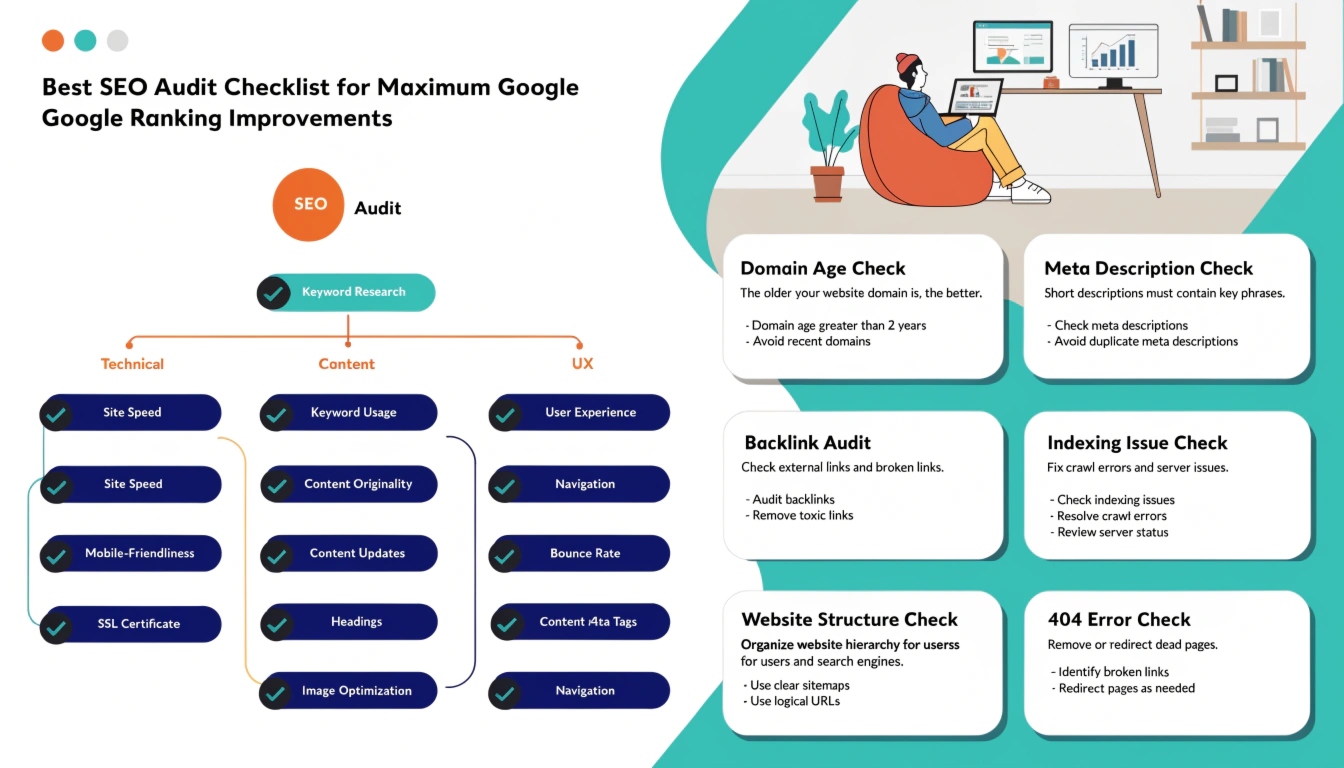
These days, having a website is no longer enough to be successful. There are millions of websites competing with each other to get their place in Google’s search engine results page, but only those sites that have been fully optimized manage to do this successfully. Your site may not be doing well because of some underlying problems with it.
This is the reason why you need to perform an SEO audit.
SEO audit is a health analysis of your website that identifies the weak points and suggests investment areas that will help your website rank higher by driving more traffic and conversion. Think about it as a map that shows you why your website does not rank well in the search results by Google.
An SEO audit is not just an error-free activity, it is a process through which your site will become organized and search engine friendly.
Below you may find a list of the SEO audit tasks that will give you maximum benefits.
1. Technical SEO Audit: Strengthening Your Website Foundation
Technical SEO is the backbone of your website. The best content won't be able to rank if your pages aren't crawled, indexed, and understood by the search engines.
Website crawlability is the first step in performing a technical audit. Your essential pages shouldn't be prohibited in your robots.txt file and indexing should never be unintentionally prevented by your meta tags. The Google search console will prove very important here because it will help detect crawling issues, indexing difficulties, and dead links.
The next step is the XML sitemap. An effective sitemap guarantees that all significant web pages are identified by the search engines. As you add more content, it will automatically update itself.
The other ranking factor is the speed of your website. If you have a sluggish website, it will give poor user experience and a high bounce rate. You can save a lot of time by optimizing your images, implementing caching, reducing the use of unnecessary scripts, and having a good host provider.
Being mobile-responsive is also important. With Google's Mobile First Indexing policy, the mobile version of your website becomes the primary website for Google searches. The performance of your mobile site will directly affect your rankings.
Finally, the application of HTTPS technology is no longer optional. HTTPS provides your site with more credibility and is a factor that affects Google search rankings.
Technical SEO Audit Checklist:
- Make sure it is well crawlable and indexable
- Fix robots.txt and noindex issues
- Create and maximize XML sitemap
- Increase the speed of page loading
- Enable mobile responsiveness
- Implement HTTPS on all pages
2. On-Page SEO Audit: Optimizing Each Individual Page
The purpose of On-page SEO includes optimizing content and HTML to ensure higher relevance and visibility on the web pages.
First, it is essential to create title tags and meta descriptions. The page title should include keywords and match the content on the page. Also, make sure the page description is eye-catching for users to click through.
Additionally, pay attention to the header structure. A properly structured page will have one H1 tag and many H2 and H3 tags. Such organization helps users and search engines understand how content is structured.
Keywords placement is another aspect that needs to be considered. Instead of keyword stuffing, use them in titles, headings, introductions, and the main body.
Finally, the URL structure is another key component of SEO. Make your URLs short and clear to improve usability and rankings.
Internal linking can also help strengthen your website's authority. Linking related pages improves SEO performance and increases time spent on the website.
On-Page SEO Checklist:
- Optimize title tags and meta descriptions
- Create proper headings (H1, H2, H3)
- Use keywords naturally within content
- Create clean URLs
- Add internal links
3. Content Quality Audit: The Heart of SEO Success
The most important criterion for Search Engine Optimization (SEO) is content. There is nothing that can ensure your growth, even when you optimize your website technically, if your content is of poor quality.
User intention will always coincide with content that ranks high. It means that your content should be able to cater to user intentions instead of merely focusing on keywords.
In addition, the content should also have depth. Content that lacks depth hardly ever performs well in the search engine results pages. Rather, it is only content that covers a topic thoroughly that can perform well.
Readability is another crucial consideration here. For this reason, it is important that your content is organized into small paragraphs, subheadings, and uses simple language to help users read and understand.
It is important that you avoid duplication of content since this will cause confusion and reduce the ranking possibilities of your content. Each page should be distinct.
Content Audit Checklist:
- Match your content to the search intent
- Create detailed and high-value content
- Increase readability and organization of your content
- Avoid duplicate or superficial content
- Refresh old content frequently

4. Keyword and Competitor Analysis: Finding Ranking Opportunities
Your SEO approach depends on the strategy behind your keyword selection. Your valuable content may not receive any traffic without proper keyword usage.
Select both short-tail and long-tail keywords. Long-tail keywords work exceptionally well because they are not very competitive and are very specific.
It is also essential to consider your competition. You can also identify what type of content Google prefers for specific queries by analyzing highly ranked sites within your industry. You can analyze such factors as the length of content, content structure, backlinks, and keyword usage.
Identifying the gaps within your competitor’s content helps you create better content that beats their content ranking.
Keyword & Competitor Checklist:
- Analyze high-intent keywords
- Use variations of long-tail keywords
- Analyze competing websites
- Find content gaps and opportunities
- Map keywords to individual pages
5. Backlink audit: Building Authority and Trust
Backlinks are one of the most effective ranking signals when used on Google. These are recommendations from other websites.
An ideal backlink portfolio comprises links from credible and relevant sources. Backlinks, however, do not necessarily have to be useful in terms of boosting your site's ranking.
As part of an SEO audit, you should also consider examining the backlink portfolio of your website. You can either eliminate or disavow bad backlinks and focus on generating natural backlinks.
It is also essential to maintain diversity in anchor texts. These include brand anchors, generic anchors and keyword-focused anchors.
Backlink Audit Checklist:
- Check the credibility and relevance of your backlinks
- Disavow bad links
- Develop high-credibility backlinks
- Maintain diversity of natural anchors
- Avoid spammy link-building techniques
6. User Experience (UX) and Engagement Optimization
The search engine gives more priority to user experience when ranking sites. Despite all your efforts in SEO, poor UX may negatively impact your site’s ranking.
Such metrics as the bounce rate, session duration, and user interactions are important. If users leave your website quickly after opening it, it means that the users don’t appreciate the information available or poorly arranged.
The navigation must be user friendly and easy. You should get what you need in just several clicks.
Moreover, Core Web Vitals also positively contribute to user experience. It consists of such metrics as loading speed, interactivity, and visual stability. You should optimize them.
UX Checklist:
- Improve bounce rate and interactions
- Optimize website navigation
- Improve Core Web Vitals
- Improve readability and layouts of each page
7. Image and Media Optimization: Boosting Speed and Visibility
Images can make your website attractive, but at the same time, using them incorrectly can cause your website to load slowly.
Optimize images without sacrificing quality and adopt new image formats like WebP. Every image should have some descriptive alt text with proper keywords wherever required.
The right file naming is also helpful for SEO. Instead of meaningless file names like IMG123, name the files according to their contents.
Image Optimization Checklist:
- Resize images for fast loading
- Add descriptive alt texts
- File name optimization
- Adopt modern image formats
8. Tracking, Analytics, and Continuous SEO Improvement
SEO is not a single task, it has to be observed and improved. Google Analytics and Google Search Console are useful to monitor performance, such as source of traffic, ranking of keywords, and user activity.
Audits enable you to be on top of the changes in the algorithms and ensure high ranking. Long-term SEO success involves updating old content, and enhancing pages that perform poorly.
Tracking Checklist:
- Monitor traffic and rankings
- Analyze user behavior and conversions.
- Repair indexing and crawl problems
- Regularly update content
- Implement changes in Google algorithms
Final Thoughts
The key to a long-term search engine success is a comprehensive SEO audit. It guarantees that your site is technically stable, full of content, easy to use and authority-based.
With this combined SEO audit checklist, you can methodically find the weak points and convert them into ranking opportunities. Constant improvement and strategic implementation is the true strength of SEO, rather than a one-time optimization.
When used properly, this SEO audit will go a long way to improve your Google rankings, organic traffic, and assist your site in making long-term digital authority.